Grow procedural creatures from causes, not catalogs
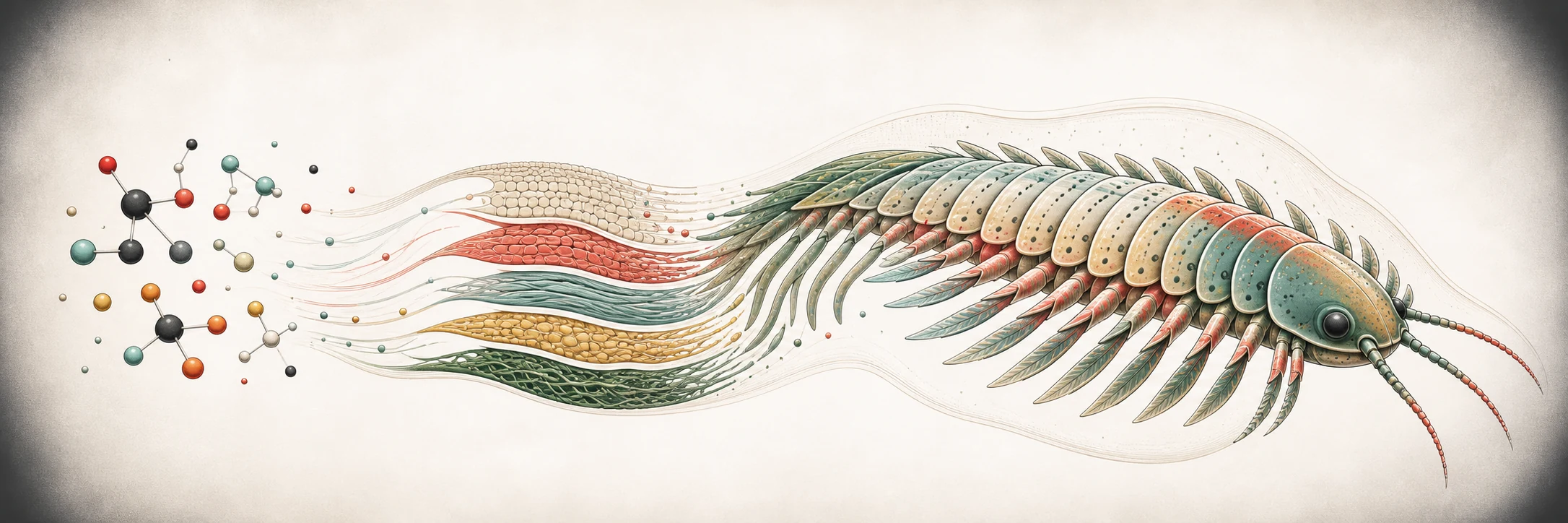
Lifecycle Kit grows procedural creatures from causes rather than an inventory of authored parts. Chemistry determines tissue, lived diet and activity reshape that tissue, biological scaling laws set organism-level constraints, compositional rules emit vector geometry, and pigment plus self-shadowing produce renderer-neutral visual data.
Every stage is a pure function over plain objects. There is no hidden randomness, browser global, clock, rendering-engine dependency, or runtime dependency. That makes a creature serializable, replayable, and safe to grow in parallel.
The five stages
- chem — elemental properties, biomolecules, metabolism, and tissue composition.
- bio-laws — cited allometric relationships for brain mass, life history, and group size.
- forms — a small vocabulary of continuous vector rules that emits body plans.
- pigment — diet, exposure, tissue, and genetics become a palette ramp.
- assemblage — depth sorting, light, shadow, and renderer-neutral 2.5D parts.
The chem, forms, and bio-laws stages also work independently. pigment
uses chemistry, while assemblage combines form and pigment output.
world abundance + temperature
            │
            ▼
          chem ───────► bio-laws
            │              │
            ▼              │
         pigment           │
            │              │
            └──────┐       │
                   ▼       ▼
forms ─────────► assemblage ──► renderer-ready geometry, colour, depth, light
Choose your entry point
Import the narrowest stage that solves your problem. Subpaths keep bundles small and make a symbol's provenance clear.
import { chem, forms } from "lifecycle-kit";

const tissue = chem.normalise({ sugar: 0, protein: 3, lipid: 1, mineral: 0, chitin: 0, keratin: 0 });
const segment = forms.taper({ from: 0.2, to: 0.1, bulgeAt: 0.5, length: 0.4 });
For a runnable installation and stage example, continue to Get started.